 216 Reviews
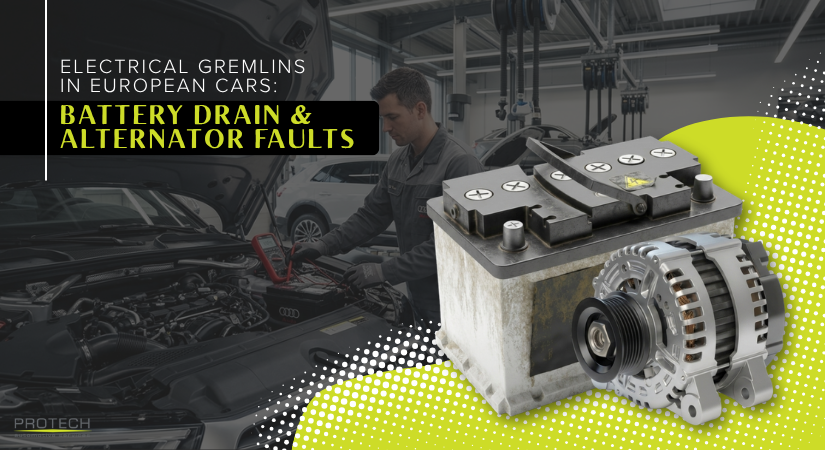
The car sat two days and now it clicks. You jump it, drive to work, and it starts fine for a week before doing it again, which is the pattern that sends people to the parts store for a third battery instead of to a shop with an amp clamp.
Batteries get blamed for problems they didn’t cause. On an Audi, a BMW or a Mercedes full of control modules, the real answer is usually a circuit that never goes to sleep or a charging system quietly running low.
Quick Summary: Key Takeaways
- Draw target: a modern European car should settle under roughly 50 milliamps once its modules sleep, and anything past 80 will flatten a good battery in days.
- Sleep takes time: many BMW and Mercedes systems need 20 to 40 minutes of quiet before the network shuts down, so quick tests miss the fault.
- Registration is part of the job: BMW and Mercedes track battery age, so a replacement that never gets registered leaves the charging strategy set for the old one.
- Water finds wiring: clogged plenum and sunroof drains soak footwell modules on Volkswagen and Audi models, and corrosion follows.
- Alternators talk now: many Volkswagen and Audi alternators are commanded over a data line, so a no-charge fault can come from the computer, not the unit.
Parasitic drain is a measurement, not an opinion
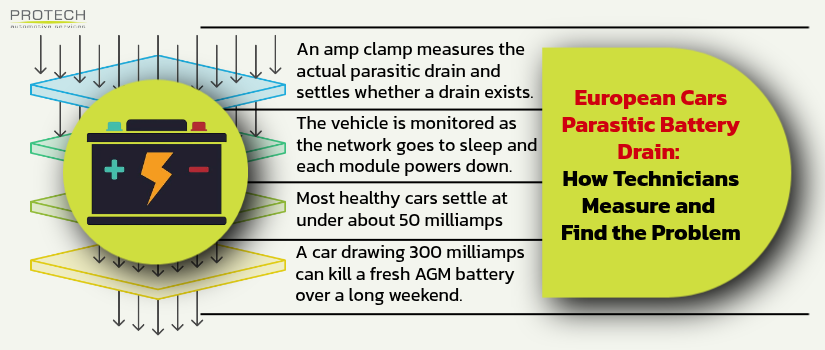
Drains either exist or they don’t, and an amp clamp settles the argument. We connect to the negative cable, close the doors, let the network fall asleep, then watch current fall step by step as each module powers down over the next half hour.
Healthy cars go quiet. Most settle under about 50 milliamps, while a car sitting at 300 milliamps will kill a fresh AGM battery over a long weekend. Then the hunt begins, one circuit at a time, until the number drops.
The usual culprits are modules and add-ons that stay awake
Something is holding the network up. A failing comfort access module, a bad trunk latch switch, a stuck door contact, or a hardwired dashcam spliced into a fuse that never shuts off will each keep the bus alive long after you walk away.
Water causes the worst of it. Blocked plenum drains on Volkswagen and Audi models pour rain into the footwell where control modules live, and once the connector pins corrode you get random faults that come and go with the weather. Rhode Island winters accelerate that. Salt and slush do the rest.
A weak charging system looks exactly like a dying battery
Charging faults mimic bad batteries. Brushes wear, a voltage regulator drifts, or an overrunning pulley seizes and squeals, and the result is a car that starts fine warm and struggles cold. We load test the battery, then watch charging voltage and ripple under load with the lights and blower running.
Cold makes all of it worse, and the federal fuel economy site notes that battery performance drops in cold weather, which makes the alternator work harder to keep the battery charged, on top of a roughly 15 percent hit to city fuel economy at 20 degrees compared with 77. That’s February in Johnston. Plan for it in October.
A new battery still needs to be registered to the car
Swapping the battery is half the job on a German car. BMW and Mercedes systems track battery age and capacity, then set charging voltage around it, so a new battery installed without registration gets charged on the old one’s profile.
That shortens its life. Match the type as well, because a car built for AGM does not want a flooded battery in the boot, and the size and vent routing matter as much as the cranking amps on the label. Registration takes a minute with the factory software. Ask whoever fits the battery to confirm the charge rate afterward.
How a diagnostic visit at Protech actually goes
We start with history, because the pattern tells us where to look. Two-day drains point at a circuit, week-long drains point at charging or battery capacity, and no-start after a car wash points at water in a connector.
Then it’s measurement. Fault memory, wake counters, current draw, voltage drop across grounds, and a look at the alternator output before anyone quotes a part. Every repair carries a 3 year, 36,000 mile TechNet warranty, and there’s a 24-hour key drop for cars that only misbehave in the morning.
Johnston drivers get a family shop that owns the right tools
We’re on Plainfield Pike in Johnston, minutes from Route 6 and the 295 interchange, and Anthony has run this shop since 2010. He’s a BMW guy himself, which is why electrical work here goes deeper than swapping parts and calling it done, and why we keep the factory-level tools these cars need.
Loaners keep you moving. Drivers from Cranston, Smithfield, Warwick and Providence bring us cars that other shops gave up on. An intermittent electrical fault needs a shop patient enough to sit there and wait for the network to fall asleep.
Frequently Asked Questions
Q: What drains a car battery overnight?
A: Some circuit that never sleeps. Common causes are a faulty control module, a bad door or trunk switch, an aftermarket accessory wired to a live fuse, and corrosion from water leaking into a footwell module.
Q: How do you test for a parasitic battery drain?
A: With an amp clamp on the negative cable, after the car’s network falls asleep. That can take 20 to 40 minutes on a European car, then technicians isolate circuits until the current reading drops to normal.
Q: Do you have to register a new battery on a BMW?
A: Yes. The car sets its charging strategy from the battery’s recorded age and capacity, so an unregistered battery gets the wrong charge rate and wears out early. Registration takes minutes with the right scan tool.
Q: Is it the battery or the alternator?
A: A load test and a charging voltage check separate them. A battery that dies after sitting points at drain or capacity, while a battery that dies while driving, often with a dimming dash, points at the charging system.
Stop buying batteries and find the actual fault
Book a diagnostic visit and we’ll measure the draw, test the charging system and tell you what’s really pulling current. Use the appointments page to pick a day.
Hours: Mon-Fri 7:30 AM-5:00 PM; Sat-Sun closed
Website: protechservice.com