 216 Reviews
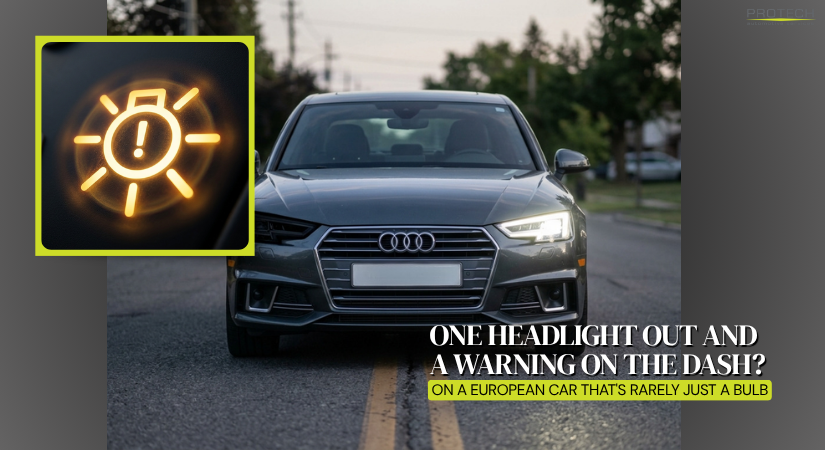
Someone flashes you on Plainfield Pike. You get out, walk around the car, and sure enough the passenger-side low beam is dark. The dash has a message about it, which somehow makes it feel more expensive.
On an Audi, BMW or Mercedes it usually is more than a bulb. These cars monitor current through every lighting circuit, run their exterior lights through control modules, and package expensive LED and xenon assemblies where road spray reaches them. Rhode Island‘s early sunsets are about to make this everyone’s problem at once, so October is the month to sort it.
Quick Summary: Key Takeaways
- The car watches the circuit: Bulb-out warnings come from current monitoring, so one can appear while the light still works.
- LEDs fail in sections: A partly dark LED strip means the module or the assembly, not a bulb you can swap.
- Moisture is the usual killer: A cracked housing lets condensation in, and corroded sockets follow within a season.
- Aim counts as much as brightness: Good-rated headlights are linked to 19 percent fewer nighttime single-vehicle crashes.
- Darkness arrives early here: Once the clocks change, most of the evening commute in Johnston happens with the lights on.
Why a European Car Warns You About Lights at All
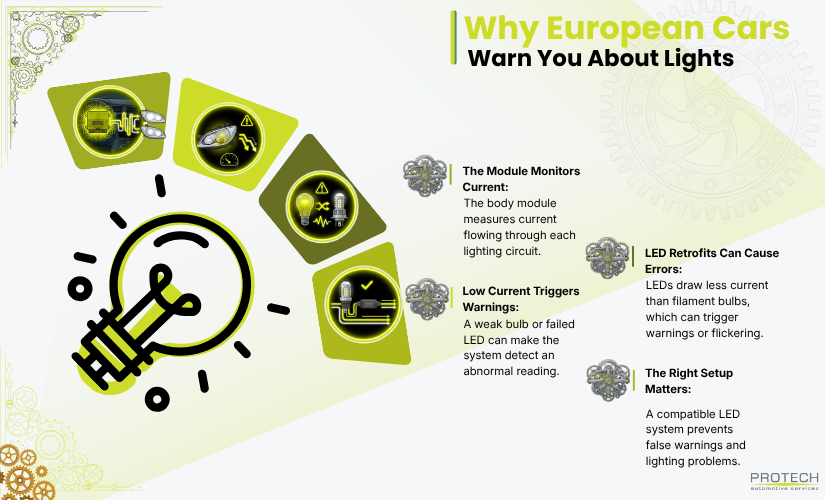
The body control module measures current on every lighting output. A filament bulb draws a known amount. When that draw stops or drops, the module knows the circuit opened and posts the message on your dash.
This is why the warning sometimes arrives before the failure. A bulb drawing slightly less than expected, or an LED assembly with a single dead emitter, reads as out of range to a module that only knows how much current went out the wire and never sees the light itself.
It also explains the LED retrofit problem. Drop an LED bulb into a socket built for a filament and the module sees almost no current, so it reports a bulb out, flickers the light, or refuses to power it at all. Cheap upgrade, expensive week.
Moisture in the Housing Does the Real Damage
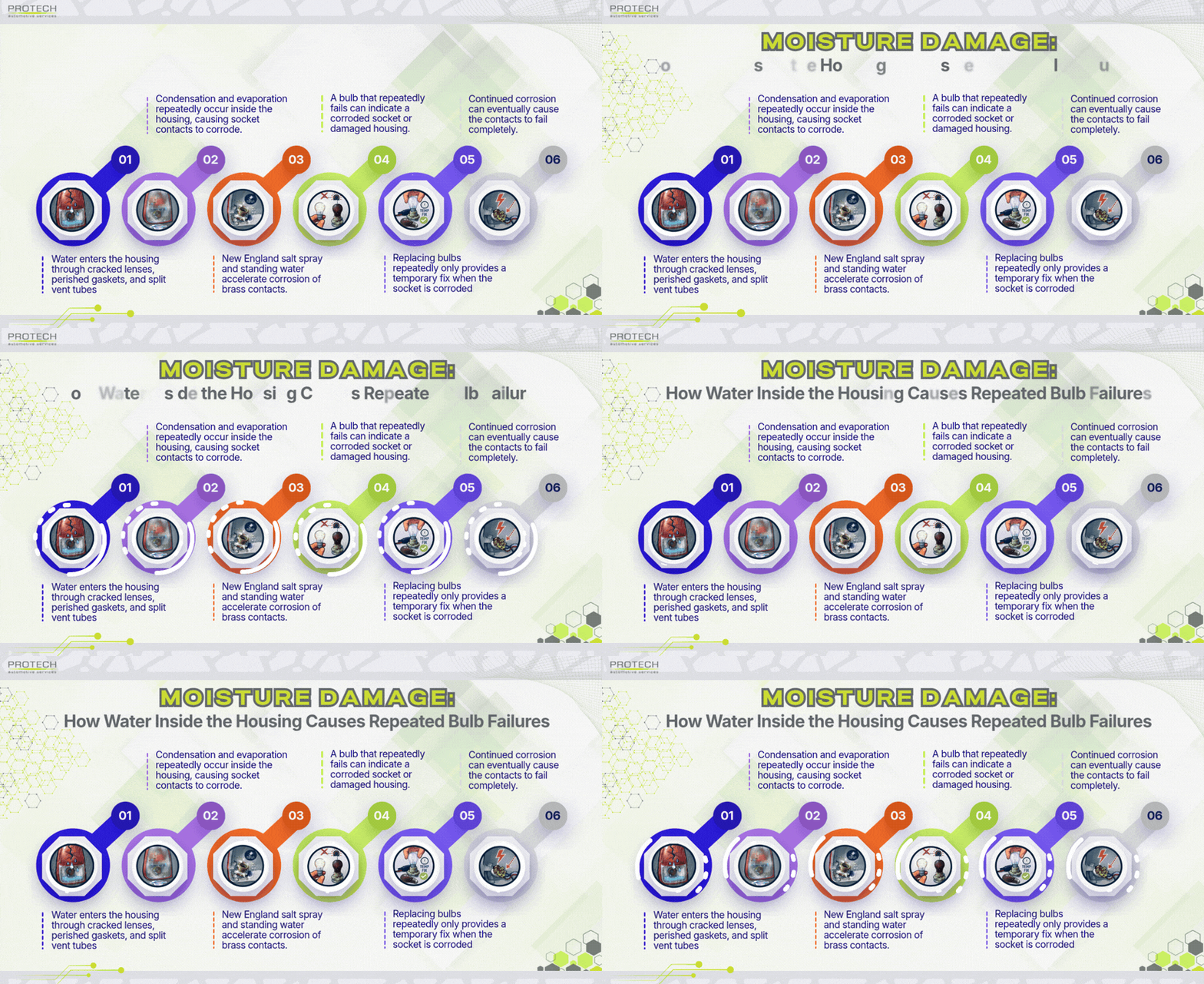
Water gets in through cracked lenses, perished gaskets and split vent tubes. Then the housing works like a terrarium — condensation overnight, evaporation in daylight, over and over until the socket contacts corrode.
New England accelerates it. Salt spray off Route 6 and the 295 interchange coats the front of the car all winter. Salt plus standing water eats brass contacts fast.
The tell is a bulb that keeps failing. If the same side goes dark twice in a year the housing is the problem, not the bulb, and dropping fresh bulbs into a corroded socket buys you a few months at a time until the contacts finally give up entirely. Stop feeding it bulbs.
Xenon and LED Systems Have Their Own Failure Points
Xenon headlights add a ballast and an igniter, and each fails in a recognizable way. A bulb at end of life turns pink or flickers on startup. A dying ballast lights up, then quits a minute later.
LED assemblies are less forgiving. Individual emitters cannot be replaced, so a strip with dark segments means the driver module or the whole housing — and that difference is most of the bill.
Adaptive systems add a layer. Cars with steering-linked or self-leveling headlights use small motors and ride-height sensors, and a fault in either one leaves you driving down Plainfield Pike with the beams aimed at the treetops or at your own front bumper.
Aim Matters as Much as Brightness on a Dark Road
A bright headlight pointed wrong is worse than a dim one aimed right. It floods the shoulder, blinds oncoming drivers, and still leaves the distance dark.
The safety data backs this up plainly. The Insurance Institute for Highway Safety reports that vehicles with good-rated visibility have 19 percent fewer nighttime single-vehicle crashes than vehicles with poor-rated headlights, from a 2022 study, and that about half of traffic deaths happen in the dark or at dawn and dusk.
Aim drifts. A minor front-end impact, a replaced bumper cover, or a failed leveling motor will all put a headlight out of position without anything looking broken. The unlit back roads between Johnston and Cranston are exactly where that costs you reaction time.
How a Lighting Diagnosis Runs at Our Shop
We read the module first. Stored lighting faults tell us which output the car believes is broken, and that beats pulling a bumper cover on a hunch. Ten minutes, not two hours.
Then it is voltage and current at the connector, a look inside the housing, and a check of the ground point. A corroded ground behind a wheel liner produces dim lights, flickering and bulb-out messages all at once.
Every repair here carries a 3-year, 36,000-mile warranty. Anthony has owned this shop since 2010. Johnston drivers find us when a dealer quotes a whole assembly for a failed ballast.
Frequently Asked Questions
Q: Why does my car say bulb out when the light still works?
A: Because the car measures current, not light. If a bulb or LED assembly draws less than the module expects, the system reports the circuit as faulty even though something is still glowing. Treat it as an early warning.
Q: Can I put LED bulbs in a car designed for halogen?
A: It usually causes problems. The car’s bulb monitoring sees the much lower current draw and reports a fault, and the reflector was designed around a filament, so the beam pattern scatters. On many European cars the module will flicker or disable the output entirely.
Q: What causes condensation inside a headlight housing?
A: A failed seal, a cracked lens, or a blocked vent tube. Housings are designed to breathe, so a little fogging after a car wash clears on its own; standing water or persistent moisture means the housing has lost its seal and the sockets will corrode.
Q: How do I know if a xenon headlight needs a bulb or a ballast?
A: Watch how it fails. A bulb near end of life shifts toward pink or purple and takes longer to strike. A failing ballast lights normally and then shuts off, or refuses to strike at all while the bulb itself tests fine.
Get the Lights Sorted Before the Evening Commute Goes Dark
Once the clocks change, most of your drive home happens with the headlights on. Book a visit and we will find out whether you need a bulb, a socket, a ballast or an assembly — and tell you which before we start.
Protech Automotive Services — 1901 Plainfield Pike, Johnston, RI 02919
Hours: Mon-Fri 7:30 AM-5:00 PM; Sat-Sun closed
Website: protechservice.com