 216 Reviews
Quick Takeaways:
- MINI turbocharged engines run hot, and their cooling systems use plastic parts that crack with age and heat cycling.
- The common failure points are the plastic thermostat housing, expansion tank, water pump, and radiator.
- Rhode Island heat and the stop-and-go of Plainfield Pike and I-295 push a MINI cooling system to its limit.
- Early signs include a gauge climbing above its midpoint, a sweet coolant smell, or low coolant between services.
- Protech Automotive Services at 1901 Plainfield Pike in Johnston provides MINI cooling system diagnosis with pressure testing and coolant condition assessment.
Johnston sits just west of Providence, where the Plainfield Pike corridor — Protech’s home street — connects the town to downtown via Route 6 and to the I-295 interchange. MINI owners running toward Federal Hill, crossing the I-295 interchange at Hartford Avenue, or heading north toward Lincoln spend a lot of summer time in stop-and-go traffic, and that is when a MINI cooling system works hardest. Rhode Island summers may be short, but they bring genuine heat, and high ambient temperature with low-speed traffic turns a marginal component into a roadside overheating event. Protech Automotive Services at 1901 Plainfield Pike provides MINI cooling diagnosis built around this driving pattern.
What are the most common causes of MINI Cooper overheating in Johnston?
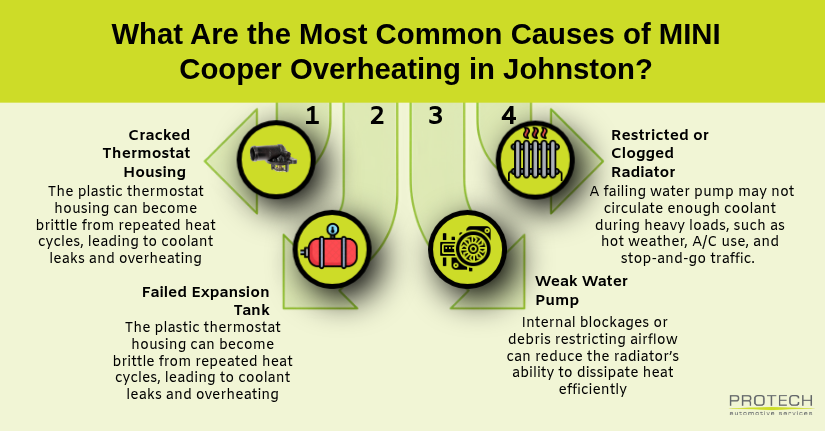
The plastic thermostat housing is one of the most frequent culprits. MINI engines use a housing molded from plastic, and after years of heat cycling, it becomes brittle and cracks, producing a leak that often shows first as a sweet smell and a slowly dropping coolant level. The expansion tank is similar plastic and fails the same way — hairline cracks that weep under pressure and worsen with heat.
The water pump and radiator round out the list. A failing pump may circulate coolant adequately at idle but fall short under the combined load of heat, AC, and stop-and-go traffic. A radiator clogged internally or restricted by road debris cannot reject heat efficiently when temperatures climb. Pinpointing the actual source requires a pressure test rather than a visual guess. Schedule a MINI Cooper cooling system inspection at Protech Automotive Services in Johnston.
Why does summer heat in Rhode Island reveal MINI cooling problems?
A cooling system has a finite reserve, and that reserve shrinks as ambient temperature rises. On a mild spring day, a MINI with a slightly weak pump or partially restricted radiator may run at a normal temperature because the system has margin. Add 90-degree heat, humidity that reduces heat rejection, the AC at full load, and an I-295 backup, and that reserve evaporates. The component marginal in May becomes the cause of overheating in July.
This is why so many failures cluster in the first real heat wave. The weakness was present for months, but only heat and traffic load were enough to expose it. The Department of Energy notes that AC and high ambient heat both increase the load a cooling system must manage — exactly the compounding effect Johnston owners feel in summer traffic. Contact Protech Automotive Services about your MINI’s temperature gauge or coolant loss.
What damage can MINI Cooper overheating cause?
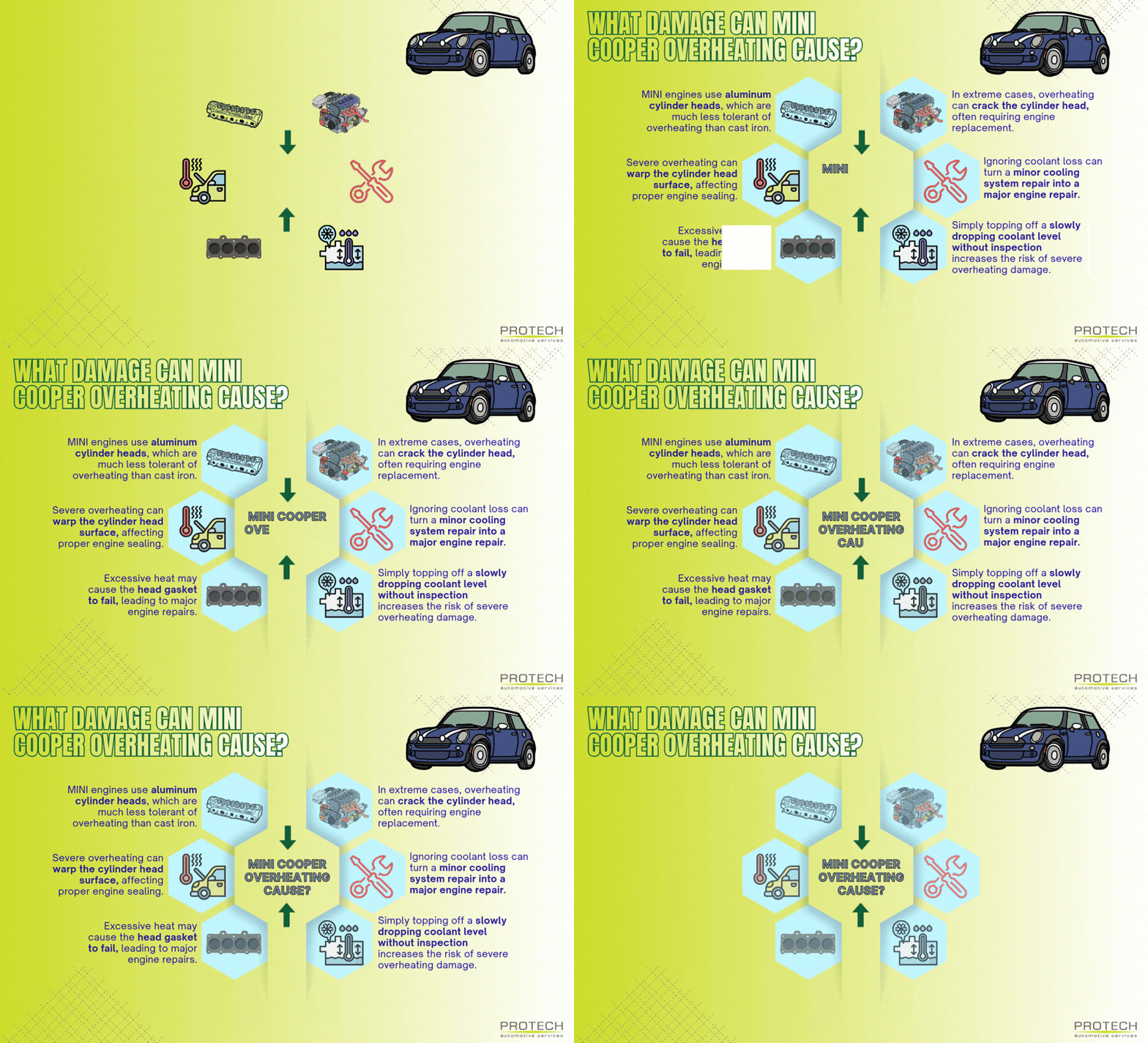
MINI engines use aluminum cylinder heads, far less tolerant of overheating than cast iron. A serious overheat can warp the head surface, fail the head gasket, or in severe cases, crack the head itself. A failed gasket is a significant but recoverable repair; a cracked head pushes toward an engine replacement.
The financial gap between catching a cracked tank or weak pump during inspection and discovering it when the gauge spikes on the I-295 on-ramp is enormous. Coolant loss left unaddressed is the path from a minor plastic-component repair to a major engine repair, which is why a slowly dropping level should never be simply topped off and ignored.
How does Protech diagnose MINI Cooper cooling system issues in Johnston?
The inspection begins with coolant condition and concentration testing, since degraded coolant loses its ability to transfer heat and resist corrosion. A pressure test follows, revealing leaks invisible at ambient pressure — pressurizing the system mimics operating conditions and makes a hairline crack in the housing or tank show itself. Thermostat operation is verified by monitoring coolant temperature against the gauge and diagnostic data. Book your MINI Cooper cooling system inspection at Protech Automotive Services in Johnston RI.
Water pump function is assessed for actual coolant flow, not just whether the motor turns, since a pump can run while its impeller fails to move adequate coolant. Together, these results let Protech identify the specific failure point and address it before a heat wave turns it into an overheating event on the highway.
Frequently Asked Questions
Q: How do I know if my MINI Cooper is running hotter than normal?
A: On a healthy MINI, the gauge sits at a consistent midpoint regardless of traffic or weather. Any upward drift — especially in stop-and-go summer driving on Plainfield Pike or I-295 — means the cooling system is working harder than it should and warrants inspection.
Q: Does Protech Automotive Services work on MINI Cooper S and JCW turbocharged models?
A: Yes — Protech services all MINI Cooper variants, including the Cooper, Cooper S, and John Cooper Works models, including their cooling systems. Contact the shop at 1901 Plainfield Pike to confirm service availability.
Q: Should I keep topping off coolant if it keeps dropping?
A: No — a level that keeps dropping means a leak that should be found and repaired. Contact Protech at (401) 464-9900 for a pressure test to locate the source before it leads to an overheating event.
Q: Does Protech Automotive Services work on other European brands besides MINI in Johnston?
A: Yes — Audi, BMW, Mercedes, Porsche, Volkswagen, and other European brands alongside MINI. Contact the shop to confirm service availability for your vehicle.
Contact
Protech Automotive Services
1901 Plainfield Pike, Johnston, RI 02919
Phone: (401) 464-9900
Website: protechservice.com
Hours: Mon-Fri 7:30 AM – 5:00 PM