 216 Reviews
BMW drivers expect smooth, responsive power delivery every time they press the throttle. When the fuel system becomes contaminated, that expectation is shattered — replaced by rough running, hesitation, hard starts, and in serious cases, engine damage. Fuel system contamination in BMWs can take several forms, and correctly identifying the source is critical to an effective repair. At Protech Automotive Services in Johnston, Rhode Island, our BMW-experienced technicians have the diagnostic expertise to identify and correct fuel system contamination issues across a wide range of BMW models.
What Is Fuel System Contamination?
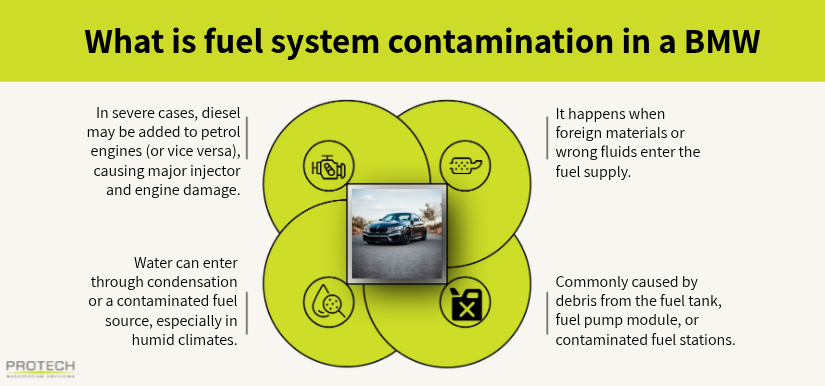
Fuel system contamination occurs when foreign materials or incorrect fluids enter the fuel supply. The most common type is physical particulate contamination — debris from a deteriorating fuel tank, a failing fuel pump module, or debris introduced during a fuel fill at a contaminated fuel station. Water contamination is another significant concern, particularly in humid climates, as water can be introduced through condensation in the fuel tank or from a contaminated fuel source. In the most serious cases, owners or service facilities have accidentally introduced diesel fuel into a petrol-powered BMW or vice versa — a mistake that can cause severe injector and engine damage.
Symptoms of Fuel System Contamination in a BMW
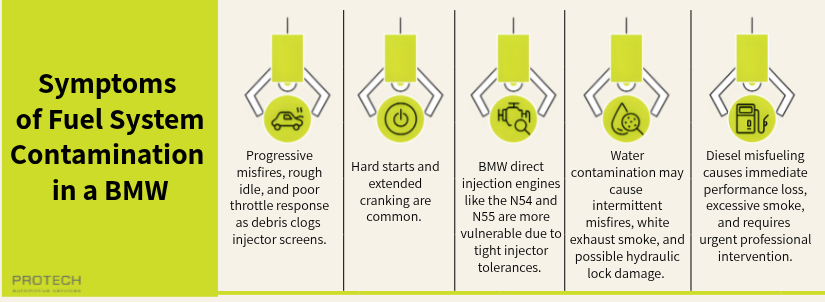
The symptoms depend on the type and severity of contamination. Particulate contamination typically causes progressive misfires, rough idle, and poor throttle response as the debris clogs the fine mesh screens inside the high-pressure fuel injectors. Hard starts and extended cranking are common. BMW direct injection engines — including the N54 and N55 — are particularly susceptible because their high-pressure injectors have extremely tight tolerances that are sensitive to contamination.
Water contamination can cause intermittent misfires, white smoke from the exhaust, and in severe cases, hydraulic lock damage to the engine. Misfueling with diesel produces immediate performance degradation, excessive smoke, and is a time-critical situation requiring immediate professional intervention.
Protech Automotive’s Fuel System Repair Process
At our BMW repair shop in Johnston, our process begins with determining the extent and type of contamination. For particulate contamination, we perform a fuel system cleaning, replace the fuel filter, inspect and clean or replace injectors, and check the fuel pump screen for damage. For water contamination, we drain and flush the tank and lines, replace the fuel filter, and check for injector damage. For misfueling events, we perform an immediate fuel system drain, flushing of all lines, filter replacement, and injector cleaning or replacement as required. Contact us online or give us a call to schedule an appointment.
Address: 1901 Plainfield Pike, Johnston, RI 02919
Phone: (401) 464-9900
Website: protechservice.com
Frequently Asked Questions
Q: How do I know if my BMW has been misfueled?
A: Symptoms of misfueling typically appear almost immediately after fueling. The engine may run very rough, produce excessive smoke, or fail to start. If you suspect misfueling, do not start the engine — call Protech Automotive Services immediately for guidance.
Q: Can contaminated fuel damage BMW fuel injectors permanently?
A: Yes. BMW direct injection injectors operate under very high pressure with extremely tight tolerances. Particulate contamination can score injector internals, causing permanent damage that requires injector replacement. Early intervention minimizes damage risk.
Q: How long does a fuel system flush and cleaning take?
A: A standard fuel system cleaning and filter replacement takes a few hours. More extensive work such as tank removal, injector cleaning, or injector replacement requires additional time. We provide a specific estimate after our diagnosis.
Q: Should I add fuel system cleaner to prevent contamination?
A: Quality fuel injector cleaners can help maintain injector cleanliness when used periodically, but they cannot flush particulate contamination from the tank or pump. Regular fuel filter replacement is the most effective preventive maintenance measure.