 216 Reviews

Every Outback generation since 2010 has a weak spot on file with federal safety regulators, and most used-car listings won’t mention it. That’s the honest answer to Subaru Outback years to avoid: it’s less a list of bad years than a list of things to check on the car in front of you. If you’re shopping for all-wheel drive this November, ahead of the first snow on Route 6, have the car inspected in Johnston before you sign.
Quick Summary: Key Takeaways
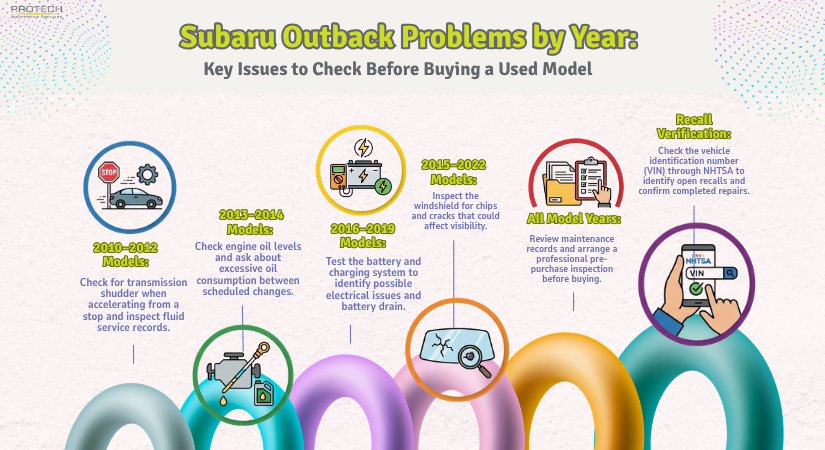
- No year is automatically bad: each generation has a documented problem area, and the inspection should target it.
- 2010 to 2012: feel for a shudder from a stop.
- 2013 and 2014: check the oil level, because oil-consumption complaints cluster on these two years.
- 2016 to 2019: test the battery and charging system.
- 2015 to 2022: look closely at the windshield, and run the VIN for open recalls on any year.
Subaru Outback Years to Avoid Are Really Problems to Check For
The smart way to read Subaru Outback problems year by year is as an inspection checklist, not a blacklist. A well-kept 2012 with records can be a better buy than a 2018 that’s never had a battery test, and only a lift and a scan tool will tell you which one you’re looking at. So skip the private-sale handshake until someone neutral has looked underneath.
Protech’s technicians are ASE certified. Their advice is blunt: if the car you’re buying has no warranty, get a pre-purchase inspection. A history report shows where the car has been, but it can’t tell you whether the brakes, mounts and electrics are safe today.
2010 to 2012 Outbacks: Feel for a Shudder From a Stop
The 2010 to 2012 Outbacks draw more power train complaints than any Outback model year since. Of the 216 power train complaints owners filed with NHTSA on the 2011 Outback, a keyword count shows 101 mention the torque converter and 41 mention a shudder.
On the test drive, pull away gently from a stop several times and feel for a judder at low speed. Ask for transmission fluid records too. The 2011 also logged 85 exterior-lighting complaints that mention headlights, so switch the low beams on before you leave the lot.
2013 and 2014 Outbacks: Check the Oil Level First
Oil-consumption complaints cluster on the 2013 and 2014 model years in the NHTSA files, and while they’re a far smaller pile than the transmission complaints on the earlier cars, they cost a buyer nothing to rule out. Pull the dipstick.
A level well below full on a car the seller says was just serviced tells you something, and so does a trunk with a quart of oil rolling around in it. Some FB-series four-cylinders burn oil between changes. That’s manageable on a car whose owner checks it monthly, and a real worry on one that’s been run low for a year.
2016 to 2019 Outbacks: Battery Drain Leads the Complaints
Electrical complaints lead the files for 2016 through 2019. Most are about the battery. NHTSA’s file on the 2017 Outback holds more than 900 owner complaints, and of the 391 filed under the electrical system as of October 2026, 331 mention the battery.
Test it no matter what the seller says. A proper inspection includes a battery and charging test, plus a scan of the modules for stored faults. A dead battery on a used-car lot in the fall is an annoyance, but the same car refusing to start in a Johnston driveway on a January morning means a tow truck and a lost day.
2015 to 2022 Outbacks: Windshields and Open Recalls
From 2015 on, the complaint that keeps piling up is glass. Visibility and wipers is the largest category in the 2015 file and in every file from 2020 through 2022, and for the 2019, 310 of the 326 complaints in that category mention the windshield. Check it in daylight. Look for chips and running cracks.
Recalls apply to every year. Some are tiny. NHTSA campaign 22V485000 covered just 182 of the 2020 and 2021 Outbacks and Legacys, for a transmission programming error that could let the drive chain slip and break. Run the VIN through NHTSA’s recall lookup, and ask for paperwork on anything that comes back open.
Rhode Island Salt Belongs on the Checklist
Any Outback that’s lived through a few Rhode Island winters needs to go up on a lift. Salt and slush from Route 6 and I-295 sit on brake lines, fuel lines, subframe mounts and exhaust hangers for months. None of it shows in a driveway.
Tires matter too. Subaru’s all-wheel drive wants four tires that match closely in size and wear, so a car on mismatched rubber may need a full set before the first storm. Price that in. Measure all four.
Frequently Asked Questions
Q: What are the worst years for the Subaru Outback?
A: By volume of power train complaints filed with NHTSA, 2010 to 2012 stand out, with 2011 the heaviest. Later years carry different issues, including battery drain on 2016 to 2019 cars and windshield cracks across 2015 to 2022.
Q: Is a used 2019 Subaru Outback a good buy?
A: It can be. Test the battery, look the windshield over for cracks, and run the VIN through NHTSA’s recall lookup before you put money down.
Q: What should a Subaru pre-purchase inspection include?
A: A road test from a stop, a computer scan, a battery and charging test, an oil level check, all four tires measured, and a look underneath for salt damage to lines and mounts.
Book the Inspection Before You Sign
Get the seller to agree to a drop-off before you shake hands. Every Protech appointment is a drop-off, the day of or the night before, so the Outback has to be left for its inspection, and that’s easier to arrange before another buyer turns up with cash. Have the VIN ready for the request form on protechservice.com, and plan the drop-off at 1901 Plainfield Pike, Johnston, RI 02919.